Spray Foam Insulation in Palmer, Alaska: The Complete Guide for Extreme Climate Protection
When winter temperatures in Palmer plunge below zero and your heating system runs constantly, you quickly learn that standard insulation simply isn’t enough for Alaska’s extreme climate. Located in the heart of the Matanuska-Susitna Valley, Palmer experiences over 205 nights below freezing each year, with temperatures ranging from 11°F to 67°F annually.
For Palmer homeowners, spray foam insulation isn’t a luxury upgrade—it’s a necessity. With energy costs running 3-5 times higher than most of the continental United States, the difference between adequate and inadequate insulation can mean thousands of dollars each year.
Palmer Climate Statistics
Why Palmer, Alaska Demands Superior Insulation
Understanding Climate Zone 7
Palmer sits firmly in IECC Climate Zone 7, one of the most demanding climate zones in the United States. The International Energy Conservation Code compliance guide for Alaska specifies that Zone 7 requires significantly higher insulation standards than virtually any other region in the country.
Palmer experiences between 9,000 and 12,600 heating degree days annually. To put that in perspective, Seattle sees about 4,500 heating degree days, while Phoenix sees fewer than 1,000. This means Palmer homes must work considerably harder to maintain comfortable indoor temperatures.
The True Cost of Inadequate Insulation
According to the Alaska Housing Finance Corporation (AHFC), heating costs in Alaska run 3-5 times higher than most of the United States. For a typical Palmer home, this translates to annual heating bills of $3,000 to $5,000 or more.
Key Climate Statistics
- 205+ nights below freezing annually
- 64 inches average annual snowfall
- 3-5x higher energy costs than Lower 48
- 9,000-12,600 heating degree days per year
Why Standard Insulation Fails in Alaska
Research conducted by Oak Ridge National Laboratory reveals a troubling reality: as outside temperatures drop, fiberglass insulation performance degrades dramatically.
Studies show that when outside temperatures dip to -8°F, R-19 fiberglass insulation performs at only R-9.2—a 52% reduction in effectiveness. In contrast, foam insulation actually performs better in colder temperatures.
Why Spray Foam Insulation is Essential for Alaska Homes
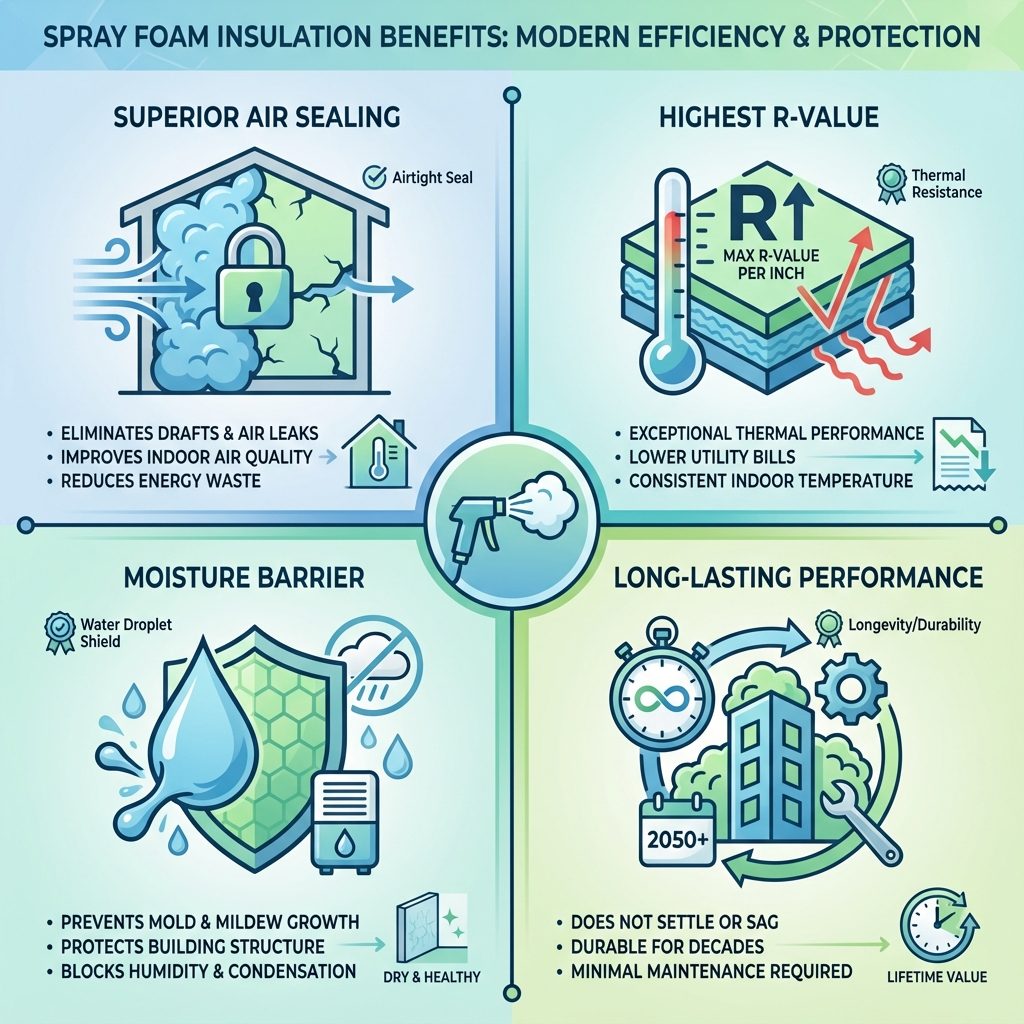
The Dual Function Advantage
What makes spray foam insulation uniquely suited to Alaska’s extreme climate is its ability to serve two critical functions simultaneously: high-performance thermal insulation and comprehensive air sealing.
When properly applied, spray foam expands to fill every gap, crack, and cavity in the building envelope. This eliminates the air leakage pathways that account for up to 40% of home energy loss.
Superior Moisture Management
Palmer’s freeze-thaw cycles create unique moisture challenges that spray foam is specifically designed to handle. Closed-cell spray foam functions as both insulation and vapor retarder, preventing moisture from migrating through wall assemblies.
The Building Science Corporation confirms that spray polyurethane insulation provides an excellent air barrier, virtually eliminating moisture problems caused by air leakage.
Closed Cell vs. Open Cell Spray Foam: Which is Right for Alaska?
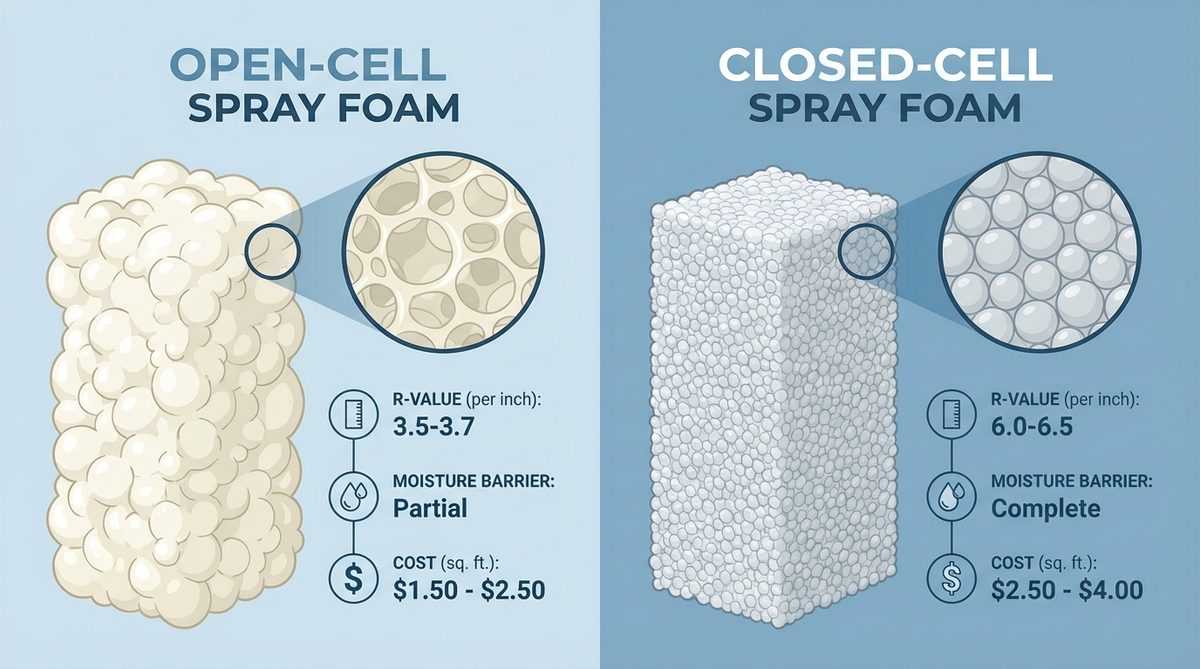
The Clear Alaska Recommendation: Closed-Cell
For Palmer’s Climate Zone 7 conditions, closed-cell spray foam is the recommended choice for all thermal envelope applications:
| Feature | Open Cell | Closed Cell | Alaska Winner |
|---|---|---|---|
| R-Value per Inch | R-3.5-3.8 | R-6-7 | Closed Cell |
| Vapor Barrier | No | Yes (at 2”+) | Closed Cell |
| Moisture Resistance | Low | High | Closed Cell |
| Air Sealing | Good | Excellent | Closed Cell |
| Structural Strength | Minimal | Significant | Closed Cell |
| Cost per Board Foot | $0.70-$1.10 | $1.20-$1.80 | N/A |
| Cold Climate Suitability | Poor | Excellent | Closed Cell |
R-Value Requirements for Palmer Alaska Homes
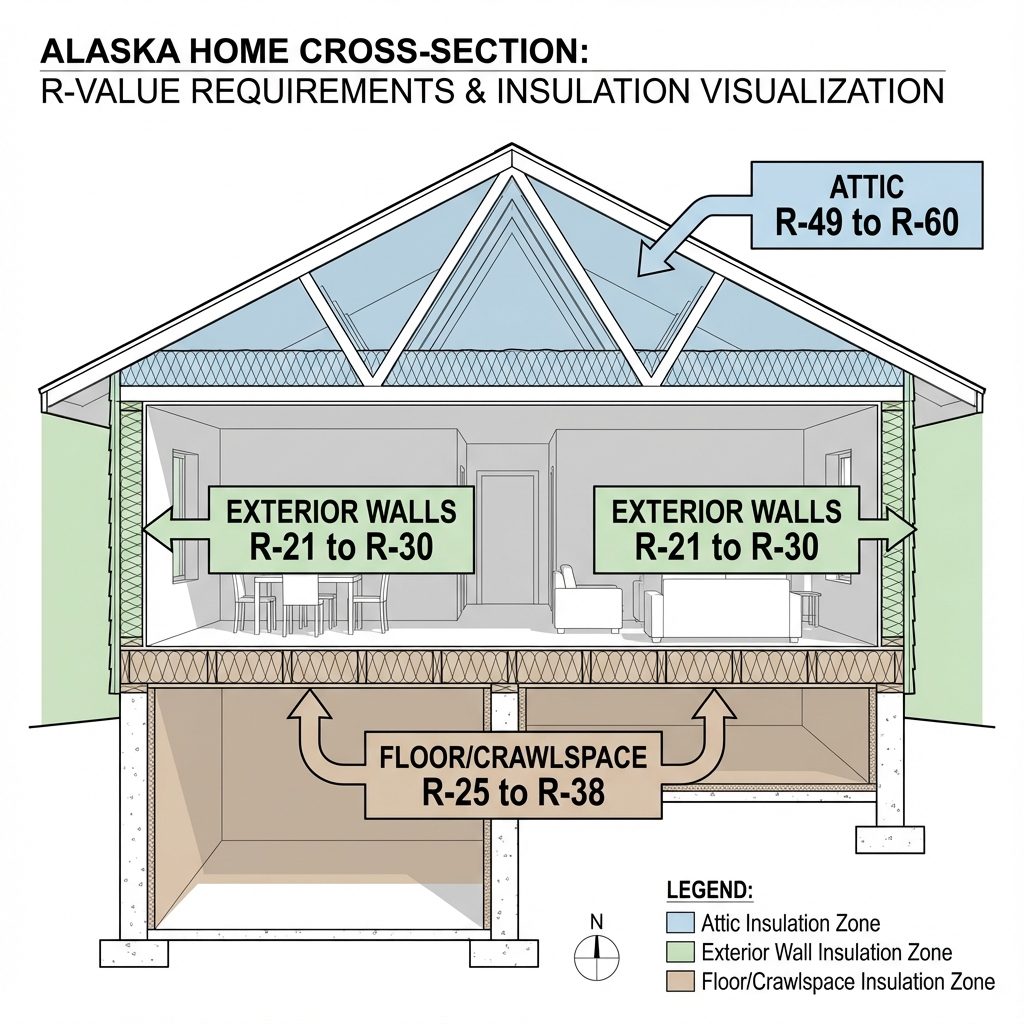
Climate Zone 7 Code Requirements
The Alaska Building Energy Efficiency Standard (BEES), administered by AHFC, establishes minimum insulation requirements:
| Building Component | Minimum R-Value | Closed Cell Thickness |
|---|---|---|
| Ceiling/Attic | R-49 to R-60 | 7-9 inches |
| Exterior Walls | R-21 to R-30 | 3-4.5 inches |
| Floors Over Unconditioned | R-38 | 5.5-6 inches |
| Crawlspace Walls | R-25 minimum | 4 inches |
| Rim Joists | R-20 minimum | 3 inches |
Why Thickness Matters for Moisture Safety
Research from the Cold Climate Housing Research Center reveals that insufficient foam thickness can actually create worse moisture problems than no foam at all. For Palmer’s climate, approximately 6+ inches of closed-cell spray foam is required to maintain safe wall temperatures.
How Spray Foam Prevents Ice Dams in Alaska
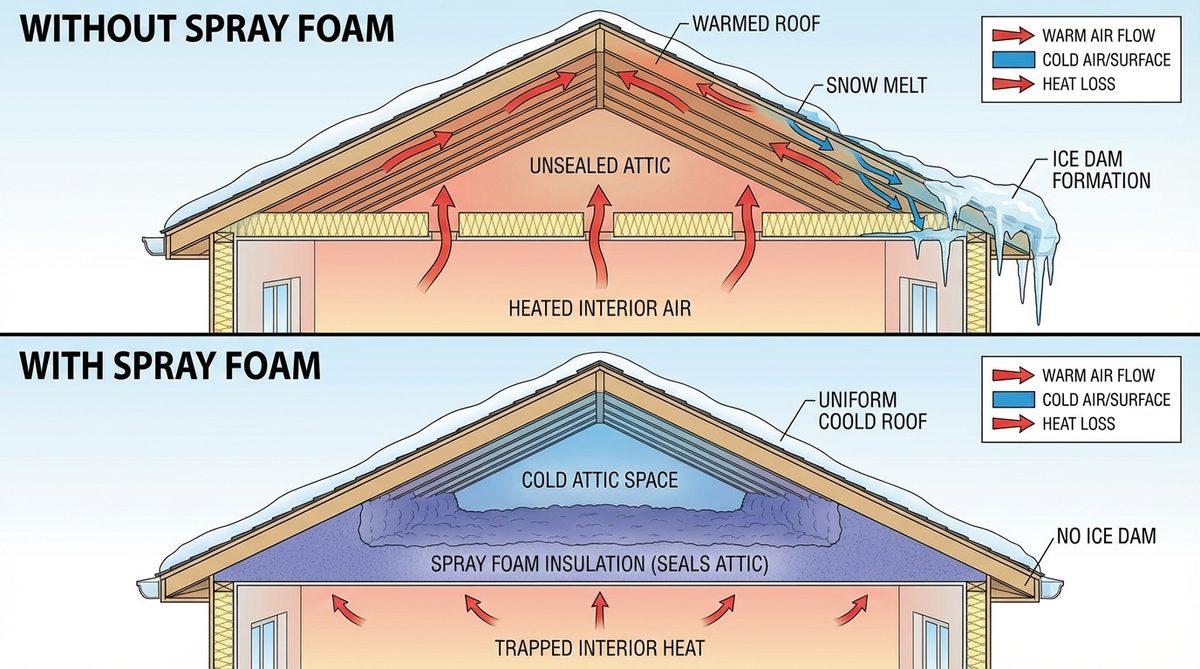
Understanding Ice Dam Formation
Ice dams form through a predictable process:
- Heat escapes through a poorly insulated attic
- Snow melts on the warm roof surface above
- Water runs down toward the colder roof edge at the eaves
- Water refreezes at the cold overhang where no heat escapes
- Ice builds up into a dam that blocks further drainage
- Water backs up under shingles and into the home
How Spray Foam Breaks the Cycle
Spray foam insulation prevents ice dams by addressing the root cause: heat escaping into the attic. When properly applied, spray foam creates an airtight seal that prevents warm air from escaping through the ceiling into the attic space.
Ice Dam Prevention ROI
Ice dam damage can cost $5,000 to $20,000+ per incident. Compare this to proper attic spray foam insulation at $4,000 to $8,000—prevention is more economical than repairs.
Spray Foam Insulation Cost in Palmer: Investment and Energy Savings
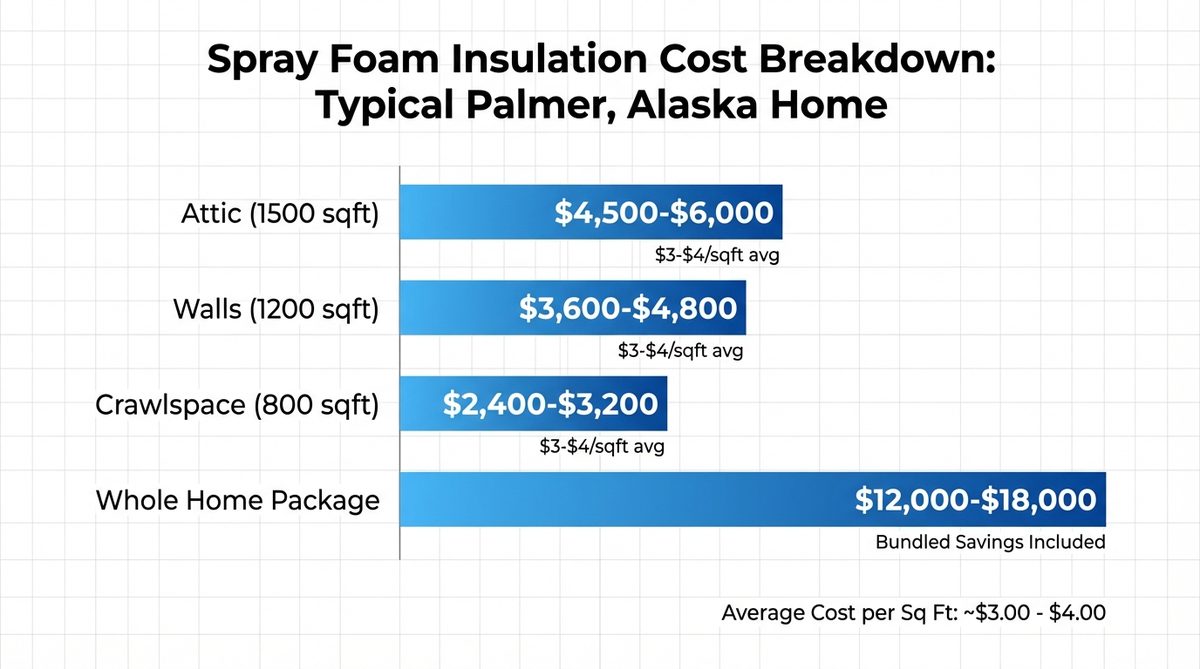
Understanding Pricing Structure
Closed-Cell Spray Foam:
- $1.20 to $1.80 per board foot
- Typical wall application (3”): $3.60 to $5.40 per square foot
- Typical attic application (7”): $8.40 to $12.60 per square foot
Typical Project Costs
| Application | Square Footage | Typical Cost Range |
|---|---|---|
| Attic Only | 2,000 sf | $4,000 - $8,000 |
| Walls Only | 1,800 sf | $6,500 - $10,000 |
| Crawlspace | 1,200 sf | $3,500 - $6,000 |
| Whole Home | Complete | $12,000 - $25,000 |
Energy Savings and ROI
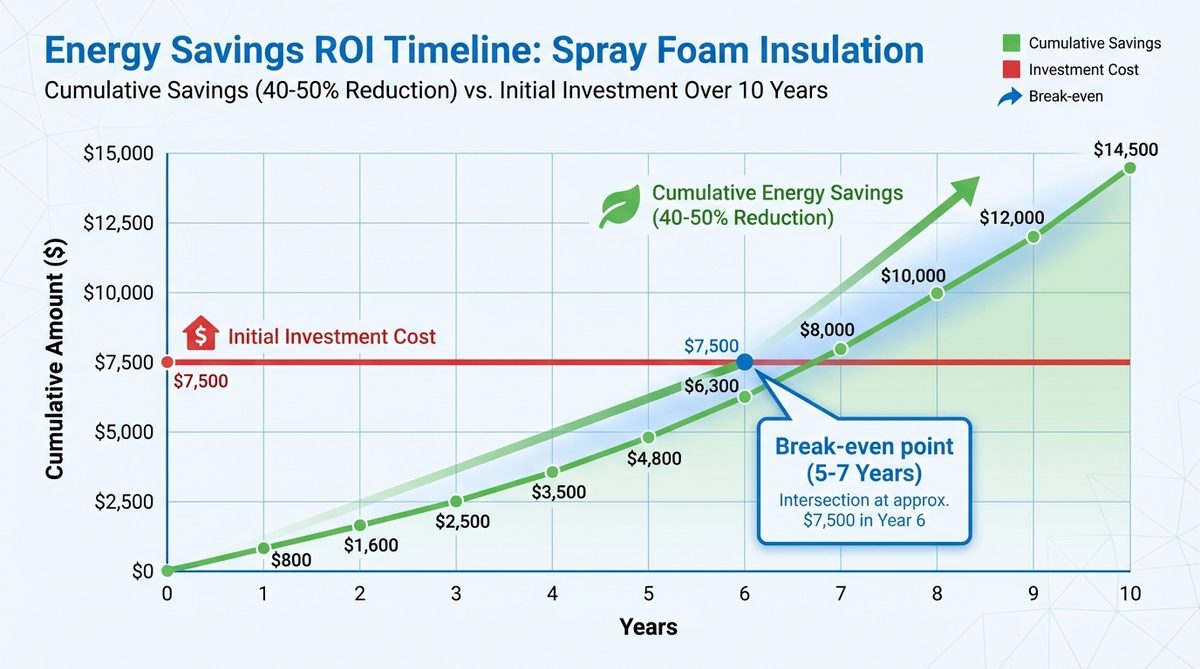
Documented energy savings from Alaska homeowners range from 40-50% reduction in heating costs:
| Factor | Before Spray Foam | After Spray Foam |
|---|---|---|
| Annual Heating Cost | $4,500 | $2,500 |
| Annual Savings | - | $2,000 |
| Spray Foam Investment | - | $12,000 |
| Payback Period | - | 6 years |
| Lifetime Savings (30 years) | - | $48,000+ |
Alaska Rebates and Tax Credits for Spray Foam Insulation
Federal Inflation Reduction Act Programs
The Inflation Reduction Act allocated $74.5 million to Alaska specifically for home energy efficiency programs:
Home Efficiency Rebates:
- $2,000 to $4,000 for improvements achieving 20-35% energy savings
- $4,000 to $8,000 for improvements achieving 35%+ energy savings
- Higher rebates available for income-qualified households
Home Electrification Rebates:
- Up to $14,000 total for comprehensive electrification projects
- 50-80% of project costs covered depending on income level
Federal Tax Credits
The IRS Energy Efficient Home Improvement Credit provides:
- 30% tax credit on qualified energy efficiency improvements
- Up to $1,200 annually for insulation improvements
- Can be combined with AHFC rebates
Maximizing Available Incentives
For a $15,000 spray foam installation project, a Palmer homeowner might access $4,000+ in AHFC rebates plus $1,200 in federal tax credits, reducing effective cost to under $10,000.
What to Expect During Professional Spray Foam Installation
Why Professional Installation is Essential
Spray foam installation requires specialized equipment and extensive expertise. According to the Cold Climate Housing Research Center, spray foam “requires a high level of experience to install correctly,” especially in Alaska’s challenging conditions.
The Installation Process
Day 1: Preparation
- Site inspection and preparation
- Masking and protection of surfaces
- Removal of old insulation if required
- Ventilation setup
Day 2-3: Application
- Spray foam applied in multiple passes
- Thickness verified throughout
- Trim and finishing as needed
- Quality inspection
Day 3-4: Curing and Completion
- 24-48 hour curing period
- Final inspection
- Cleanup and debris removal
- Walkthrough with homeowner
Frequently Asked Questions
Is spray foam insulation worth it in Alaska?
Yes, spray foam insulation is absolutely worth it in Alaska’s extreme climate. It provides superior energy savings of 40-50% reduction in heating costs, prevents ice dams, lasts 80-100 years, and acts as both insulation and vapor barrier. Most Alaska homeowners see payback in 5-7 years.
How long does spray foam insulation last in Alaska?
Spray foam insulation lasts 80-100 years in Alaska when properly installed—effectively the lifetime of your home. Closed-cell spray foam offers superior longevity due to its rigid structure and exceptional moisture resistance.
Which is better for Alaska: open cell or closed cell spray foam?
Closed-cell spray foam is definitively better for Alaska’s extreme climate. It provides R-6 to R-7 per inch, acts as a vapor barrier, and adds structural strength. For Palmer’s Climate Zone 7, closed-cell is the industry-recommended choice.
How much does spray foam insulation cost in Alaska?
Spray foam insulation in Palmer costs $1.20 to $1.80 per board foot for closed-cell foam. For a typical 2,000 square foot home, expect $4,000-$8,000 for attic, $6,500-$10,000 for walls, or $12,000-$25,000 for whole-home insulation.
Does spray foam prevent ice dams in Alaska?
Yes, spray foam insulation effectively prevents ice dams by sealing your attic and eliminating heat loss through the ceiling. Spray foam creates an airtight barrier that keeps attics cold, preventing the melt-refreeze cycle.
What R-value is recommended for Alaska homes?
Alaska Climate Zone 7 recommends: Attics R-49 to R-60, Exterior Walls R-21 to R-30, Floors R-25 to R-38, and Crawlspaces R-25 minimum.
How much can I save on energy bills with spray foam?
Palmer homeowners typically save 40-50% on heating costs after spray foam installation, equaling $1,600-$2,500 in yearly savings. Most homeowners achieve payback in 5-7 years.
Who does spray foam insulation in Palmer, Alaska?
Foamology Insulation provides professional spray foam insulation throughout Palmer, Wasilla, and the Mat-Su Valley, specializing in closed-cell spray foam for Alaska’s extreme climate.
Make Your Palmer Home Winter-Ready
Ready to reduce your heating bills and make your home truly comfortable? Contact Foamology Insulation today for a free estimate and professional assessment of your insulation needs.
Foamology Insulation serves Palmer, Wasilla, Big Lake, Houston, Sutton, and the greater Matanuska-Susitna Valley with professional spray foam insulation services. Visit our gallery to see examples of our work, or explore our services to learn more about how we can help improve your home’s energy efficiency.