R-Value Guide for Alaska: Complete Energy Savings Breakdown
Quick Answer
What R-value does your Alaska home need? Alaska requires R-49 for attics, R-20+ for walls, and R-38 for floors—the highest standards in the United States. As Zone 7-8 territory, proper insulation can reduce your heating costs by 30-50%, with typical payback in 3-5 years. This guide covers everything you need to know about energy savings insulation for Alaska homes.
Alaska Insulation Quick Facts
Alaska’s extreme climate presents unique challenges for homeowners. With winter temperatures regularly dropping below zero and heating seasons lasting 8-9 months, the insulation in your home isn’t just about comfort—it’s about survival and serious energy savings. Understanding R-value requirements is the first step toward a warmer, more affordable home.
In this comprehensive guide, we’ll break down Alaska’s specific insulation requirements, compare different insulation types, calculate your potential energy savings, and help you make informed decisions about upgrading your home’s thermal envelope. Whether you’re building new, renovating, or simply want to reduce your heating bills, this guide has you covered.
Understanding R-Value: What Alaska Homeowners Need to Know
What Is R-Value?
R-value measures an insulating material’s resistance to heat flow. According to the U.S. Department of Energy, the higher the R-value, the better the material insulates your home. Think of it as your insulation’s ability to keep the heat you’re paying for inside where it belongs.
For example, R-49 insulation resists heat transfer approximately twice as effectively as R-25 insulation. In Alaska’s climate, this difference translates directly into hundreds or thousands of dollars in heating costs annually.
Factors That Affect R-Value Performance
R-value depends on several factors beyond just the insulation type:
- Thickness and density: More material generally means higher R-value
- Compression: Compressed insulation provides lower R-value than its rating
- Moisture accumulation: Wet insulation loses effectiveness dramatically
- Thermal bridging: Heat escapes through studs, joists, and other structural elements
- Age and settling: Some insulation types lose R-value over time
Pro Tip: The Air Sealing Factor
R-value only tells part of the story. According to ENERGY STAR, up to 40% of a building’s energy loss comes from air infiltration—not just conduction through materials. The best energy savings insulation combines high R-value with complete air sealing.
Alaska’s Climate Zones and R-Value Requirements
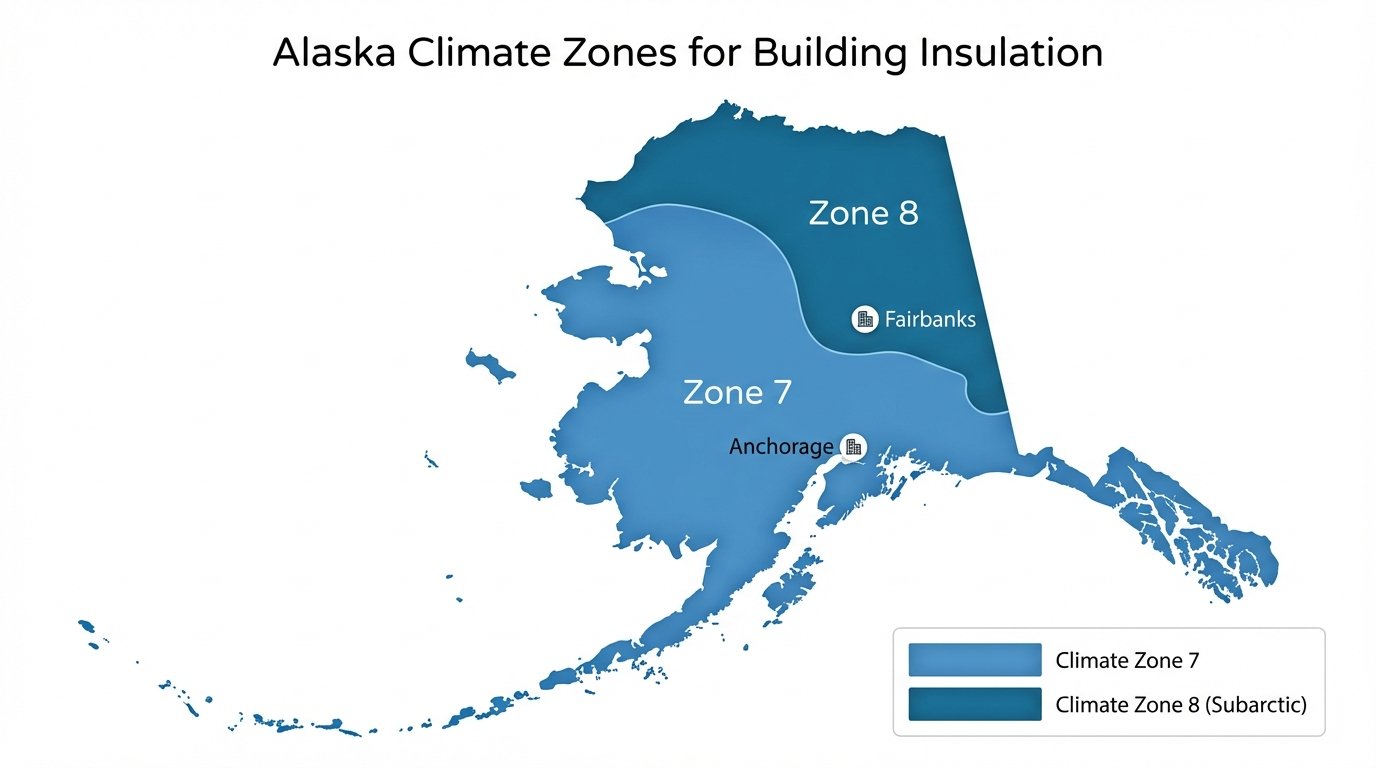
Alaska is divided into two IECC climate zones, both requiring the highest insulation standards in the United States:
Climate Zone Map
Zone 7 covers most of Alaska, including Anchorage, the Mat-Su Valley, Kenai Peninsula, and Southeast Alaska.
Zone 8 (Subarctic) includes: Bethel, Northwest Arctic, Dillingham, Southeast Fairbanks, Fairbanks North Star, Wade Hampton, Nome, Yukon-Koyukuk, and North Slope boroughs.
R-Value Requirements by Component
| Building Component | Zone 7 | Zone 8 | Notes |
|---|---|---|---|
| Ceiling/Attic | R-49 | R-49+ | Higher values recommended |
| Walls (Above Grade) | R-20+5 or R-13+10 | R-21+10 | Continuous insulation required |
| Walls (Below Grade) | R-15 | R-15+ | Basement/foundation walls |
| Floors | R-38 | R-38+ | Over unconditioned spaces |
| Slab Edge | R-10 | R-10+ | Minimum perimeter insulation |
| Windows | U-0.27 | U-0.27 | Maximum U-factor allowed |
These requirements come from the Alaska Building Energy Efficiency Standard (BEES), based on the International Energy Conservation Code. You can find detailed specifications in the Alaska Housing Finance Corporation Building Manual.
Understanding the +5 and +10 Notation
When you see “R-20+5,” this means R-20 cavity insulation PLUS R-5 continuous insulation on the exterior. This approach addresses thermal bridging through studs, which can reduce effective wall R-value by 20-30% with cavity insulation alone.
For your attic insulation, the R-49 requirement applies to the installed value—not the product rating. Compression or improper installation reduces the actual R-value below labeled performance.
R-Value Comparison by Insulation Type
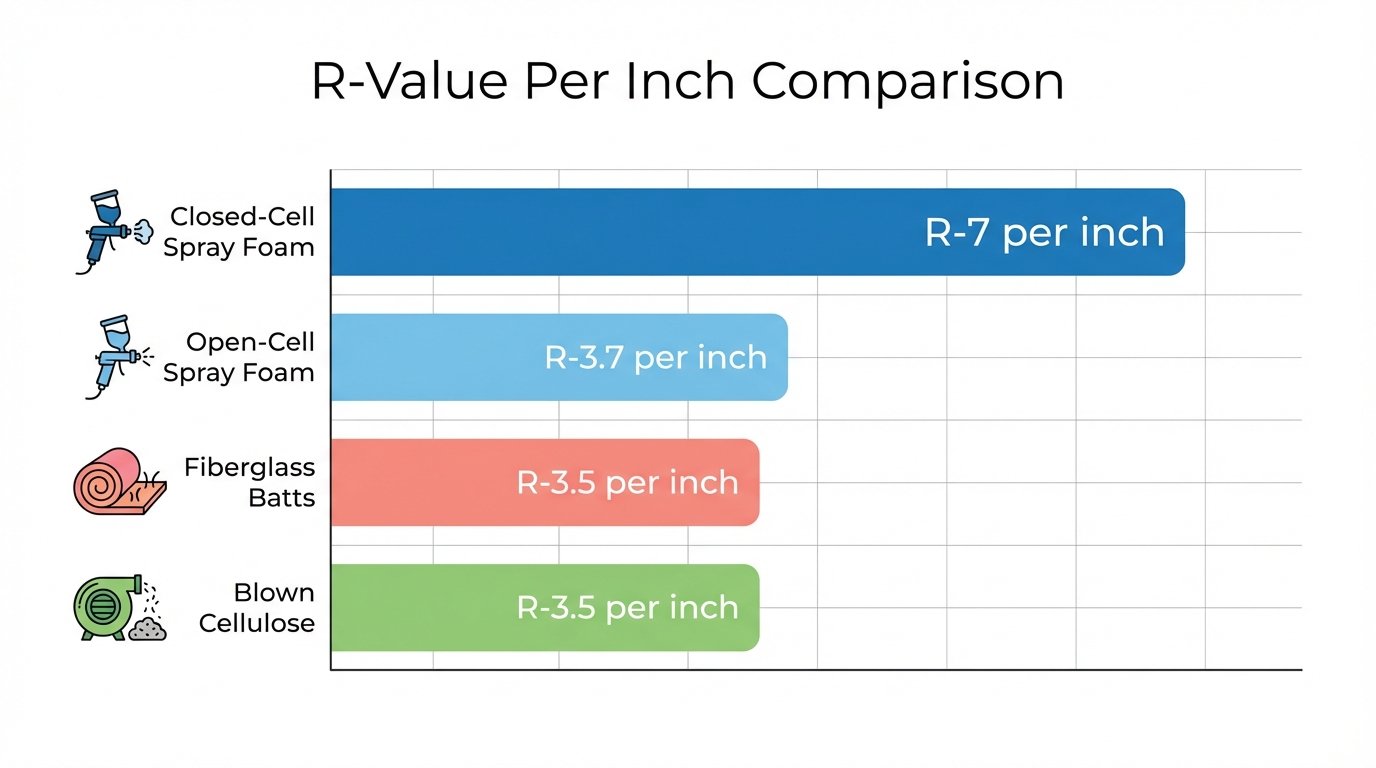
Not all insulation delivers the same R-value per inch. Here’s how the most common types compare:
| Insulation Type | R-Value Per Inch | Lifespan | Air Sealing | Cost Per Sq Ft |
|---|---|---|---|---|
| Closed-Cell Spray Foam | R-6 to R-7 | 80-100 years | Excellent | $1.50-$4.50 |
| Open-Cell Spray Foam | R-3.5-3.7 | 80-100 years | Good | $1.00-$3.00 |
| Fiberglass Batts | R-2.2-3.8 | 15-20 years | Poor | $0.10-$0.50 |
| Blown Cellulose | R-3.2-3.8 | 20-30 years | Partial | $0.50-$1.50 |
| Rigid Foam Board | R-4-6.5 | 50+ years | Partial | $0.50-$2.00 |
Why Spray Foam Excels in Alaska
For Alaska’s extreme conditions, closed-cell spray foam offers distinct advantages:
- Highest R-value per inch: Achieve R-49 in just 7-8 inches vs. 14-16 inches of fiberglass
- Complete air barrier: Eliminates the 40% energy loss from air infiltration
- Moisture resistance: Acts as its own vapor barrier, preventing condensation
- Structural strength: Adds rigidity to walls, important for Alaska’s wind and seismic conditions
- Longevity: Lasts 80-100 years without settling or degradation
According to Building Science Corporation, closed-cell foam over 2 inches thick controls vapor diffusion in all climates—particularly important in Alaska where temperature differentials create significant moisture drive.
Thickness to Achieve R-49
Closed-cell spray foam: 7-8 inches Open-cell spray foam: 12-14 inches Fiberglass batts: 14-16 inches Blown cellulose: 14-16 inches
Spray foam achieves the same R-value in roughly half the space, making it ideal for retrofit projects with limited cavity depth.
Energy Savings Potential in Alaska
Alaska’s high heating costs make insulation upgrades particularly rewarding. Let’s look at the real energy savings insulation can deliver.
How Much Can You Save?
Research from the Alaska Housing Finance Corporation shows:
- 30-50% reduction in heating costs with proper insulation
- 50,000+ Alaska households saved an average of 30% through AHFC programs
- Typical annual savings: $1,200-$2,500 depending on home size and current conditions
Sample Energy Savings Calculation
Alaska Home Energy Savings Example
Current situation:
- 2,000 sq ft Anchorage home
- Annual heating cost: $4,200
- Existing attic: R-30 (below code)
- Air leakage issues present
After spray foam upgrade to R-49 + air sealing:
- Annual heating cost: $2,520
- Annual savings: $1,680 (40% reduction)
- Upgrade cost: $6,000
- Payback period: 3.6 years
Over 10 years, this homeowner saves $16,800. Over 20 years: $33,600.
Return on Investment Timeline
In Alaska, insulation upgrades typically pay for themselves in 3-5 years—faster than almost anywhere else in the country. Several factors accelerate your ROI:
- High heating costs: Alaska’s energy prices amplify savings
- Long heating season: 8-9 months of heating maximizes benefit
- Extreme temperature differentials: Greater temperature difference = greater savings
- Air sealing benefits: Combined approach maximizes energy savings insulation value
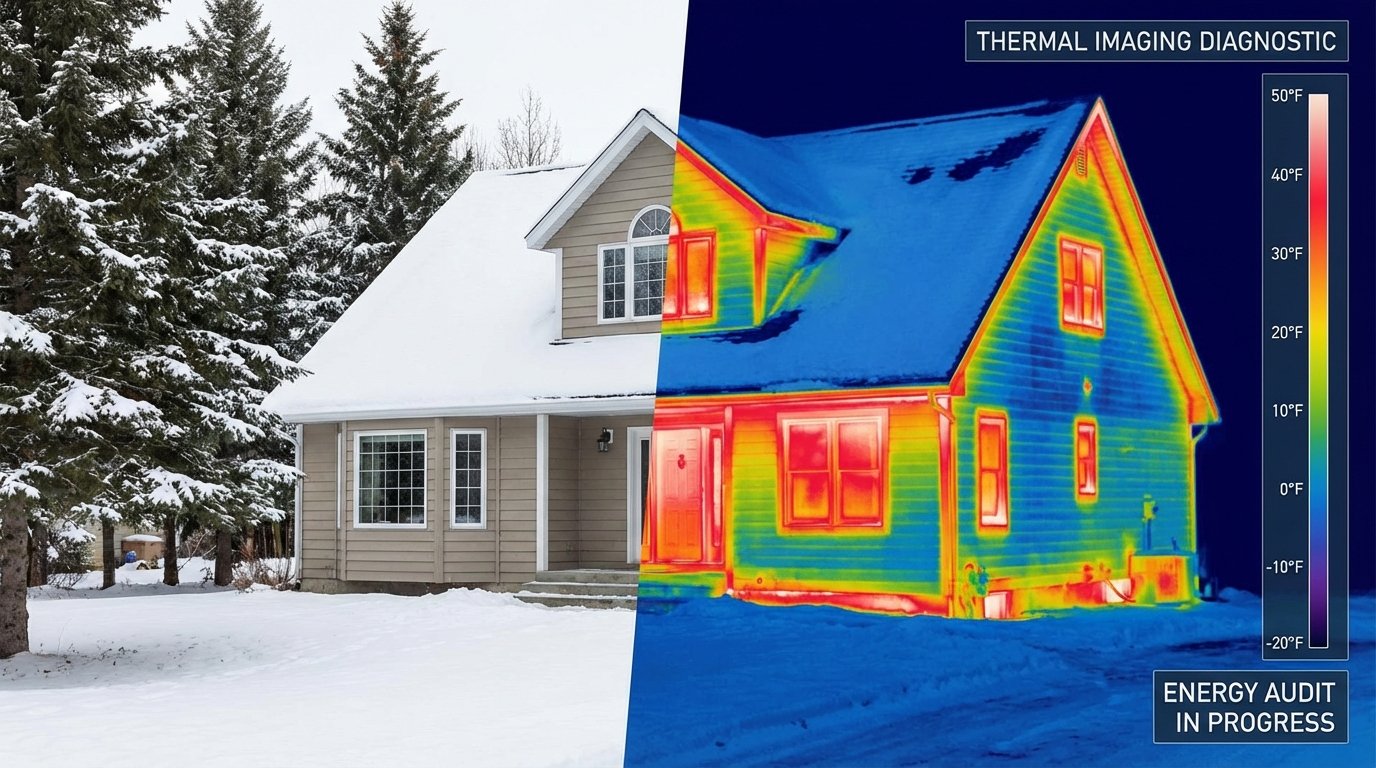
A thermal inspection can identify exactly where your home loses heat and calculate your specific savings potential.
Factors That Increase Savings
Your energy savings will be highest if:
- Starting with inadequate or damaged insulation
- Combining insulation with comprehensive air sealing
- Taking a whole-house approach (attic + walls + floors)
- Using professional installation for optimal performance
- Addressing weatherization issues simultaneously
Special Considerations for Alaska Homes
Alaska presents unique challenges that don’t exist in the Lower 48. Here’s what you need to know.
Permafrost Areas
Permafrost Considerations
In permafrost areas, standard insulation practices don’t apply. Engineering analysis is required for any ground-contact insulation. Heat from your home can thaw permafrost, causing structural damage from uneven settling that may cost tens of thousands to repair.
Buildings in permafrost areas should be constructed on open, ventilated crawl spaces that minimize heat transfer to the frozen ground. The UAF Cooperative Extension provides detailed guidance on permafrost construction.
Slab-on-Grade Construction
Ground temperatures in Alaska hover around 33°F year-round. According to AHFC guidelines:
- Full slab insulation required: Minimum 2 inches rigid foam under entire slab
- Perimeter-only insulation is NOT adequate for Alaska
- Slab-on-grade construction is not recommended for main living areas
- Radiant floor heating systems require additional insulation considerations
Ice Dam Prevention
Ice dams form when heat escapes through your roof, melting snow that refreezes at the eaves. This causes:
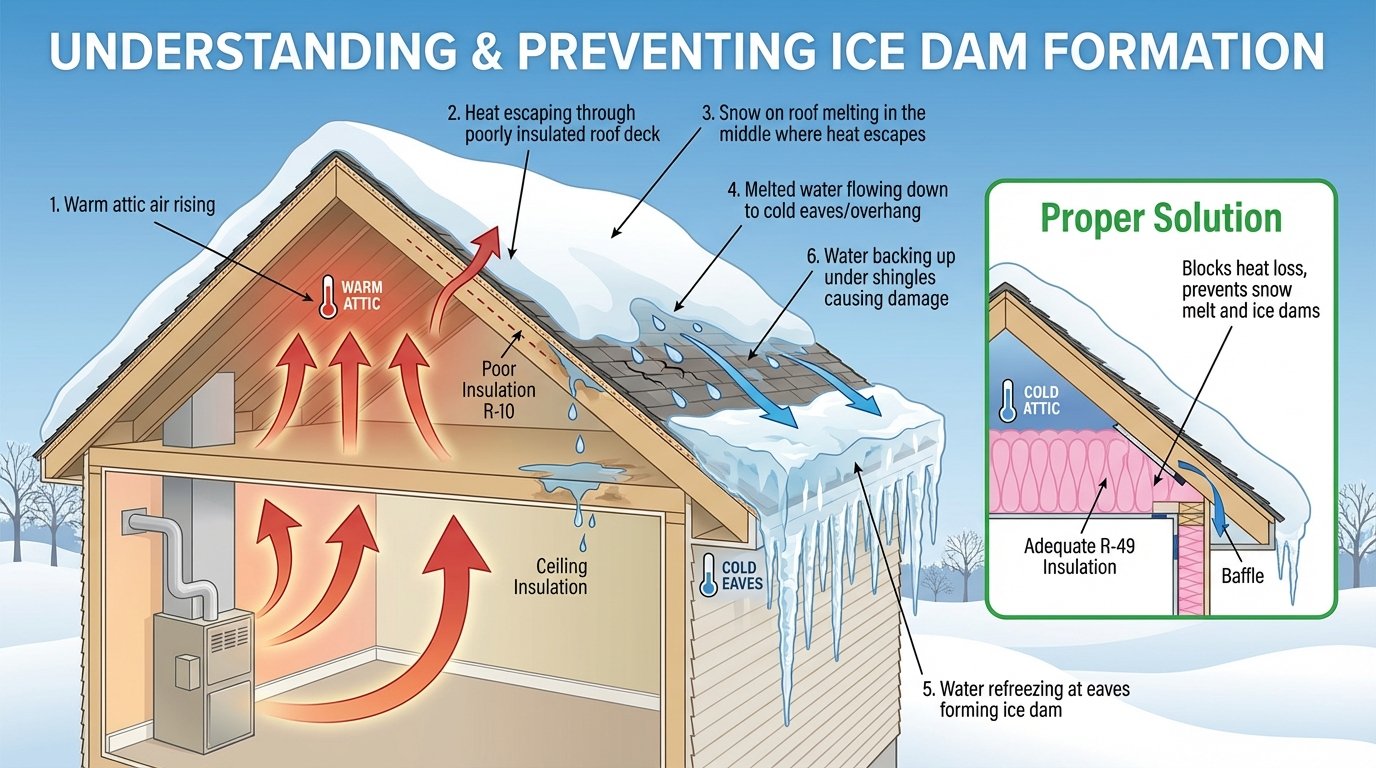
- Water backing up under shingles
- Interior water damage
- Icicle formation (safety hazard)
- Gutter damage
The solution is maintaining proper attic insulation and eliminating heat escape. R-49 attic insulation combined with air sealing prevents the warm attic conditions that create ice dams. Learn more about ice dam prevention strategies.
Spray foam applied directly to the roof deck is particularly effective because it creates both insulation and an air barrier in one application, addressing both heat loss mechanisms simultaneously.
Rebates and Incentives for Alaska Homeowners
Significant financial assistance is available to offset insulation upgrade costs:
AHFC Home Energy Rebate Program
The Alaska Housing Finance Corporation offers rebates up to $10,000 for energy efficiency improvements:
- Requires before/after energy rating
- Tiered rebates based on improvement level
- Available for existing homes
- Covers insulation, air sealing, windows, and more
Federal Tax Credits (Inflation Reduction Act)
The federal government offers 30% tax credits on qualifying energy improvements:
- Maximum $1,200 per year for insulation
- Applies to materials and installation costs
- Available through 2032
- Claimed on your federal tax return
Weatherization Assistance Program
Income-qualified Alaska residents may receive free energy improvements through the Weatherization Assistance Program:
- No-cost energy audit and improvements
- Priority for elderly and disabled residents
- Covers insulation, air sealing, heating system repairs
- Contact AHFC for eligibility
These programs can reduce your out-of-pocket costs by 30-100%, dramatically improving your return on investment.
How to Choose the Right Insulation for Your Alaska Home
Assessing Your Current Insulation
Signs your insulation needs attention:
- Uneven temperatures between rooms
- High heating bills relative to home size
- Cold floors, walls, or ceilings
- Ice dams or icicle formation
- Drafts near windows, doors, or outlets
- Insulation visible damage or settling
Best Applications by Area
Attic/Ceiling (R-49 minimum):
- Best choice: Closed-cell spray foam on roof deck
- Alternative: Blown cellulose over existing (if adequate depth available)
- Creates conditioned attic, protects ductwork
Walls (R-20+5 minimum):
- Best for retrofit: Dense-pack cellulose or injection foam
- Best for new construction: Closed-cell spray foam
- Always address thermal bridging with continuous insulation
Crawl Space/Floor (R-38 minimum):
- Best choice: Closed-cell spray foam with encapsulation
- Provides moisture control and air sealing
- Transforms crawl space into conditioned space
Basement Walls (R-15 minimum):
- Closed-cell spray foam on concrete walls
- Critical for moisture control
- Prevents condensation and mold
Working with Professionals
For optimal results, work with qualified contractors:
- AHFC-certified weatherization contractors
- SPFA-certified spray foam installers
- Look for Alaska-specific experience
- Request references from similar projects
- Get detailed written estimates
Our building consultant services can help you assess your current situation and develop a comprehensive improvement plan.
Frequently Asked Questions
What R-value do I need for my home in Alaska?
Alaska recommends R-49 to R-60 for attics, R-21 to R-30 for walls, and R-25 to R-30 for floors. Most of Alaska is in Climate Zone 7, with some areas in Zone 8, which have the highest insulation requirements in the United States. The minimum building code requires R-49 for ceilings, R-20+5 for walls, and R-38 for floors.
What is Alaska’s building code for insulation?
Alaska follows the Building Energy Efficiency Standard (BEES) based on the IECC. Minimum requirements include R-49 for ceilings, R-20+5 or R-13+10 for above-grade walls, R-15 for below-grade walls, R-38 for floors, and windows with U-0.27 maximum. These are the most stringent requirements in the United States due to Alaska’s extreme climate.
How much can I save on heating bills with better insulation?
Alaska homeowners can reduce heating costs by 30-50% with proper insulation and air sealing. AHFC reports their weatherization programs have saved over 50,000 households an average of 30% annually on energy bills. For a typical Alaska home spending $4,000-5,000 per year on heating, this means potential savings of $1,200-2,500 annually.
What is the best insulation for Alaska homes?
Closed-cell spray foam insulation is considered optimal for Alaska due to its high R-value (R-6 to R-7 per inch), moisture resistance, and superior air sealing properties. It requires less thickness to achieve R-49 (about 7-8 inches vs 14-16 inches for fiberglass) and lasts 80-100 years.
Is spray foam worth the extra cost in Alaska?
Yes, spray foam is typically worth the higher upfront cost in Alaska. The 30-50% energy savings combined with Alaska’s high heating costs means spray foam typically pays for itself in 3-5 years—faster than in warmer climates. Read our detailed analysis: Is Spray Foam Worth the Cost?
Which climate zone is Alaska in?
Most of Alaska is in IECC Climate Zone 7. The following boroughs are in Zone 8 (subarctic): Bethel, Northwest Arctic, Dillingham, Southeast Fairbanks, Fairbanks North Star, Wade Hampton, Nome, Yukon-Koyukuk, and North Slope. Both zones have the highest insulation requirements in the United States building code.
How do I prevent ice dams with proper insulation?
Ice dams form when heat escapes through the roof, melting snow that refreezes at the eaves. Prevent ice dams by ensuring R-49 or higher attic insulation combined with comprehensive air sealing. Spray foam applied to the roof deck is particularly effective as it creates both insulation and an air barrier. Learn more at our ice dam prevention page.
Are there rebates for insulation in Alaska?
Yes, several programs offer rebates and assistance. AHFC’s Home Energy Rebate Program provides up to $10,000 for energy efficiency improvements. Federal tax credits under the Inflation Reduction Act offer 30% of project costs (maximum $1,200/year for insulation). Income-qualified homeowners may qualify for free improvements through the Weatherization Assistance Program.
Do I need different insulation in permafrost areas?
Yes, permafrost areas require special engineering considerations. Standard ground-contact insulation practices don’t apply because heat from the building can melt permafrost, causing structural damage. Buildings in permafrost areas should be constructed on open, ventilated crawl spaces to minimize heat transfer to the ground and prevent uneven settling.
What’s the difference between open-cell and closed-cell spray foam?
Open-cell spray foam has R-3.5-3.7 per inch, is less expensive ($1-3/sq ft), and is best for interior walls and soundproofing. Closed-cell spray foam has R-6-7 per inch, costs more ($1.50-4.50/sq ft), but provides moisture resistance, acts as a vapor barrier, and adds structural strength. For Alaska’s extreme conditions, closed-cell is recommended for attics, crawl spaces, and exterior applications.
Conclusion: Invest in Your Alaska Home’s Energy Future
Alaska’s extreme climate demands the highest insulation standards in the United States—and for good reason. Proper energy savings insulation isn’t just about comfort; it’s about dramatically reducing your heating costs and protecting your home from moisture, ice dams, and structural damage.
Key takeaways from this guide:
- R-49 attic insulation is the minimum for Alaska (Zone 7-8)
- 30-50% energy savings are achievable with proper insulation
- 3-5 year payback makes insulation upgrades financially smart
- Spray foam offers superior performance for Alaska’s conditions
- Rebates and tax credits can offset 30-100% of costs
Whether you’re building new, upgrading an existing home, or simply trying to reduce your heating bills, investing in proper insulation delivers returns for decades to come. With 80-100 year lifespan from quality spray foam installation, it’s truly a once-in-a-lifetime improvement.
Get Your Free Alaska Home Insulation Assessment
Discover your home's R-value needs and potential energy savings. Our experts provide comprehensive evaluations for Alaska homeowners, identifying the most cost-effective upgrades for your specific situation.
This article provides general information about Alaska insulation requirements and energy savings potential. Actual savings vary based on home size, current insulation, heating source, and other factors. Consult with a qualified contractor for accurate estimates for your specific situation. For current BEES requirements and rebate programs, contact the Alaska Housing Finance Corporation.
Last updated: December 20, 2025